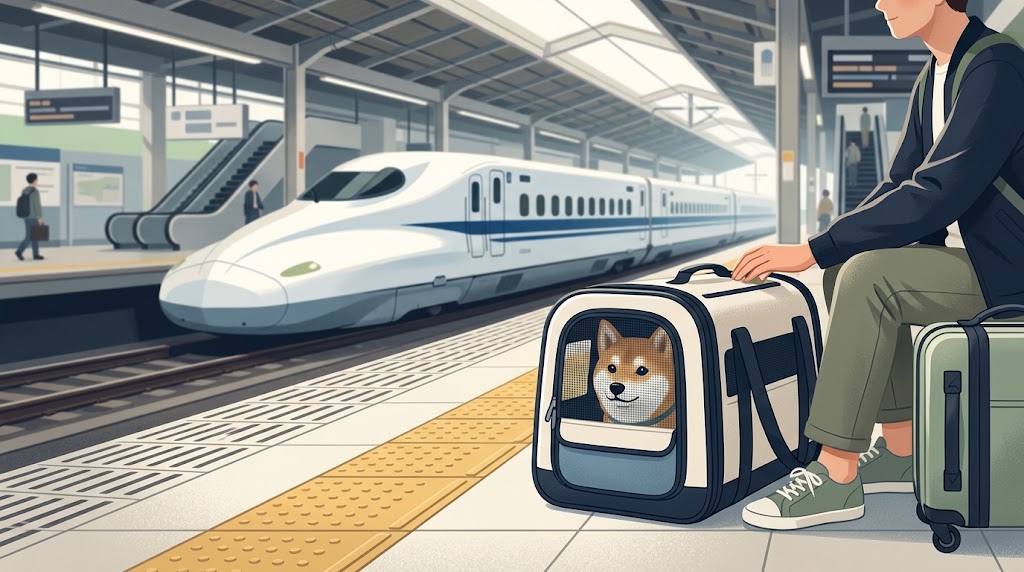
Planning to bring a dog on Japan’s high-speed rail can raise a practical question: are dogs on Shinkansen (新幹線) allowed? In general, small dogs can travel when fully enclosed in a suitable carrier, but the rules vary by JR operator. The operator matters. Your route affects the carrier’s size and weight limits, as well as how you buy any required pet ticket.
Before boarding, check the rules for your route and confirm them on the operator’s official website, since the guidance can change. A pet ticket covers carrying the case, not a passenger seat. Ordinary services require dogs to stay inside their carriers; special dog-friendly events are separate, limited-time arrangements.
- Dogs on Shinkansen: Are They Allowed?
- Compare Shinkansen Pet Rules by JR Operator
- Check Your Dog Carrier’s Shinkansen Size and Fit
- Buy a Pet Ticket and Board the Shinkansen
- Check Whether Your Dog Qualifies as an Assistance Dog
- Distinguish Ordinary Dogs on Shinkansen From Special Events
- Conclusion
- Sources and Further Reading
- Frequently Asked Questions
Dogs on Shinkansen: Are They Allowed?
Small Dogs Can Travel Inside a Compliant Carrier
Yes, in many cases. Small dogs may travel on Shinkansen (新幹線), Japan’s high-speed rail service, when they meet the railway’s pet conditions. That permission does not mean a dog can ride freely beside you: ordinary pet travel depends on railway rules and a suitable carrier. JR East, JR Central, and JR West publish separate guidance, so the same carrier or ticket assumption may not work for every route.
For ordinary pet travel, the dog stays fully inside a carrier that qualifies under the railway’s rules, including in stations and aboard the train. JR Central requires animals to remain in their cases in stations and trains, while JR East says a dog cannot be carried in your arms, on a leash alone, or in a sling that does not meet the rules. These details matter if your dog is used to sitting on a lap or riding in a soft bag that leaves part of its body exposed. Small size alone does not create an exception.
A Pet Ticket Does Not Reserve a Passenger Seat
The ticket is not a seat reservation. For JR East, the relevant charge is a hand-luggage ticket (手回り品きっぷ), which covers the qualifying pet case rather than a passenger seat. It does not provide a seat number or reserve space beside you. The pet is carried under baggage rules, not booked as a second passenger.
A reservation for your seat does not change the carrier conditions or create permission to open the case during the journey. Likewise, paying a pet-related charge does not make a dog eligible to sit outside its case or occupy a separate seat. The pet case and your passenger booking are separate parts of the trip, with different rules. This distinction helps prevent confusion when comparing the pet charge with your own fare.
For example, a traveler with a reserved seat has a reservation for that passenger, while the dog’s case remains subject to the railway’s pet rules. The charge is not payment for a neighboring seat, and an empty seat is not automatically part of the pet arrangement. Exact limits, charges, and purchase steps differ by operator, so there is no single pet-ticket procedure to assume across all Shinkansen routes. Identify which railway operates your Shinkansen before choosing a carrier or buying a ticket.
Compare Shinkansen Pet Rules by JR Operator
JR East Allows Up to 120 Cm in Total Dimensions
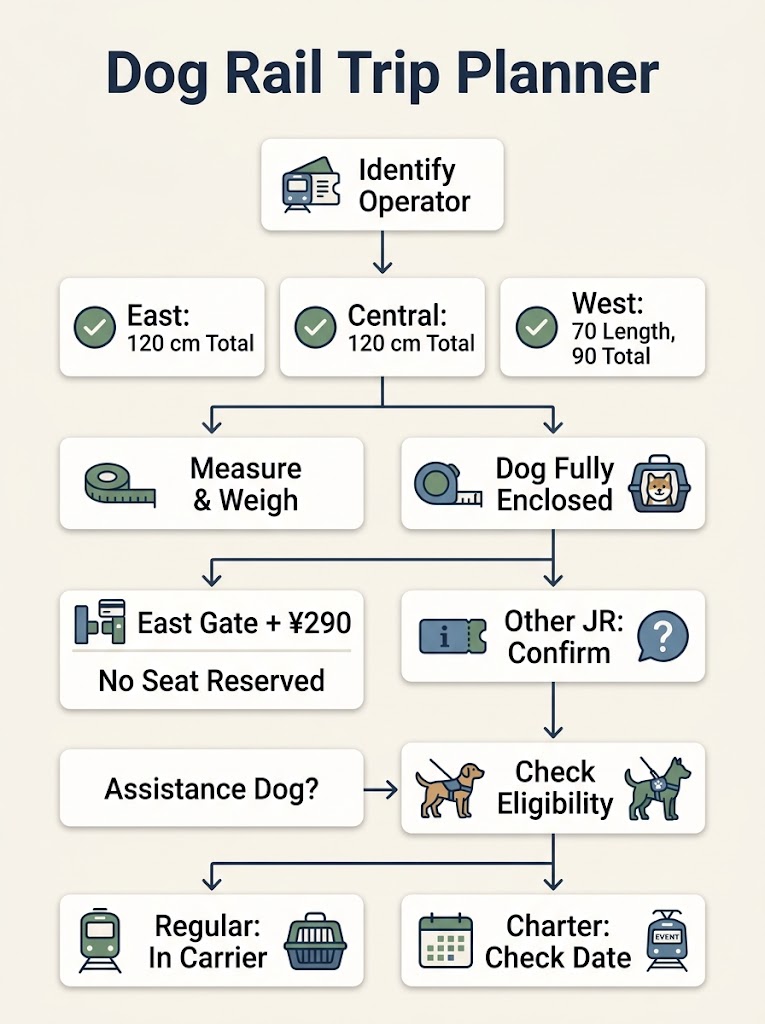
Rules differ by operator, even on the same high-speed rail network. The total is the key. JR East permits a dedicated carrier whose length, width, and height add up to no more than 120 cm, with the dog and carrier together weighing no more than 10 kg, according to JR East’s English luggage guidance. The 120 cm figure is the sum of all three sides, not a limit for each side.
JR East’s English FAQ states a ¥290 per pet case charge. Its passenger rules classify the charge as a hand-luggage fee, and the amount applies per item for each passenger ride. These JR East pages have no publication dates, so the published limits and fee may change. Shinkansen pet rules differ by operator, so an accepted carrier under JR East’s policy is not automatically accepted elsewhere.
JR Central Uses a 120-Cm Total Limit
JR Central uses the same headline dimensions as JR East. That is not the full comparison. According to Central Japan Railway Company, a pet case’s three dimensions may total no more than 120 cm, while the animal and case together must weigh no more than 10 kg. The limit is based on the combined measurement and weight, not on the carrier alone.
JR Central charges ¥290 per pet case, according to its English guidance. That matches the stated JR East fee, but the matching price does not make every other condition identical across operators. If a trip uses services governed by different JR operators, the relevant carrier limits may not be the same throughout the journey. The guidance page is undated, so current terms take precedence.
JR West Sets a 70-Cm Length and 90-Cm Total Limit
JR West sets a smaller dimensional allowance than JR East and JR Central. Its English train-usage guidance limits the carrier to 70 cm in length and 90 cm across all three dimensions combined. The dog and carrier together may weigh no more than 10 kg. Its limit is tighter.
JR West says a fee is required for a pet, but its English guidance does not give the amount. That differs from JR East and JR Central, which state a ¥290 charge per pet case. Compare your route’s operator with the table before buying or packing a pet carrier. JR West’s guidance page is undated, so treat its published terms as subject to change.
| Operator | Carrier dimensions | Combined weight limit | Stated pet-case fee |
|---|---|---|---|
| JR East | Three dimensions total: up to 120 cm | Up to 10 kg | ¥290 |
| JR Central | Three dimensions total: up to 120 cm | Up to 10 kg | ¥290 |
| JR West | Length: up to 70 cm; total: up to 90 cm | Up to 10 kg | Fee required; amount not stated in English guidance |
JR East and JR Central share the same stated total-dimension and combined-weight limits, and both list a ¥290 pet-case fee. JR West uses a smaller total-dimension limit and also caps carrier length, while its English guidance does not state the fee amount.
The table shows why a single carrier rule or price cannot be assumed for every route. The operator’s published guidance pages are undated, so check current official terms before travel.
Check Your Dog Carrier’s Shinkansen Size and Fit
Measure the Complete Case, Including Handles and Wheels
Measure the complete carrier, not just its shell. Handles, wheels, pockets, and other parts that extend beyond the main body can change the outside dimensions used for a size check. Soft cases can bulge when packed. Measure the full carrier and weigh it with your dog before heading to the station.
The limits depend on the operator. JR East and JR Central allow a case whose three dimensions total no more than 120 cm, with the animal and case together at or below 10 kg. JR West instead limits case length to 70 cm, total dimensions to 90 cm, and combined weight to 10 kg. JR Central explicitly counts handles and wheels toward its size and weight limits.
A total-dimension rule adds length, width, and height; it does not mean each side can reach the stated total. A case can meet the limit in two dimensions but exceed it once all three are added. For JR West, the 70 cm length cap is an additional test, not a replacement for its 90 cm total-dimension limit.
Keep Your Dog’s Entire Body Inside the Case
The case has to contain your dog completely. A dog’s head, legs, or tail cannot remain outside while the train is moving or while you are in the station; JR East’s guidance says the animal must be fully inside its case. This is a fit requirement, not just a comfort preference for boarding.
JR West says the carrier must hold the pet’s entire body, so a case that covers only the torso does not meet its guidance. A carrier that leaves part of the dog exposed does not satisfy the full-body condition. The requirement applies even if the dog is calm or held close by its owner.
Weight and containment are separate checks. A lightweight carrier does not solve a fit problem if the dog cannot remain fully inside it. For a dog close to the carrier’s available space, a roomier case may fit better, but it still needs to meet the relevant operator’s dimension and combined-weight limits.
Check Whether a Pet Stroller Can Be Separated
A sling is not automatically a compliant carrier. JR Central says cloth items such as dog slings are unsuitable cases, and JR East says a sling that does not meet the case rules cannot be used instead of a compliant container. The key test is not the product label, but whether the carrier meets the railway’s size, weight, and containment conditions.
A stroller frame can create a separate size issue. JR East says a pet stroller that exceeds the carrier limit cannot be brought aboard as the dog’s carrier. If the compliant pet case separates from the frame, the case and folded frame may be carried separately under the applicable baggage rules; that is not blanket approval for every stroller.
A stroller is not a workaround for an oversized carrier. Separating the parts may help only when the pet case itself meets the route’s limits and the folded frame qualifies under baggage rules. Since those rules can differ by operator, the stroller’s frame and the dog’s case are assessed as separate items in this situation.
| Check | What to inspect | Common problem prevented |
|---|---|---|
| Full external dimensions | Length, width, height, and protruding parts | Exceeding an operator’s size limit |
| Combined weight | Dog and carrier together | Going over the weight allowance |
| Full-body containment | Dog stays fully inside the case | Head, legs, or tail outside |
| Slings | Whether the sling meets carrier rules | Using an unsuitable cloth carrier |
| Stroller frame | Whether it separates and folds | Treating an oversized stroller as a compliant case |
The checks cover both the carrier itself and how the dog fits inside it. A case can meet the weight limit yet still fail the size or containment requirements, so one measurement alone does not establish compliance.
Strollers add another distinction: the pet case and frame may be treated separately when the case detaches, but the frame remains subject to baggage rules. Compare each part with the rules for the operator on your route.
Buy a Pet Ticket and Board the Shinkansen
JR East: Show the Carrier at the Boarding-Station Gate
JR East’s published guidance asks travelers to show the pet inside its carrier at the ticket gate of the station where they board. In practical terms, show the carrier at the gate before proceeding with the pet’s boarding arrangements. This is a pet check, not a request for a passenger seat reservation. Since JR East’s guidance pages have no publication date, confirm the current instructions before travel.
The gate step is separate from buying the pet ticket, which JR East says must happen before boarding. For JR East, take the carrier to the boarding-station ticket gate and buy the required ticket before boarding; check with other operators for their process. The station where your Shinkansen trip begins is the relevant boarding station, rather than a transfer station you may use later.
| Stage | JR East | Other operators |
|---|---|---|
| Before travel | Check current JR East guidance | Confirm the operator’s process |
| At boarding-station gate | Show the carrier | Confirm whether a gate check applies |
| Before boarding | Buy the required ticket | Follow the confirmed ticket process |
The sequence separates JR East’s stated steps from details that cannot be assumed across operators. JR East names a gate presentation and ticket purchase before boarding; this does not make those exact arrangements a shared process for JR Central or JR West.
For another operator, the fee or general carrier rule alone does not tell you where to pay or when to present the case. The table treats those details as points for operator confirmation, rather than filling them in by analogy with JR East.
Buy the Hand-Luggage Ticket Before Boarding
The required item is a hand-luggage ticket (手回り品きっぷ), the ticket for carrying a qualifying pet as hand luggage. JR East lists a hand-luggage fee (手回り品料金) of ¥290 per pet case, and its passenger rules describe the ordinary hand-baggage charge as applying per item for each passenger ride. The dog travels under this baggage arrangement; the charge does not reserve a seat for the dog.
JR East says the ticket must be purchased before boarding. Its pages do not show a publication date, so the ¥290 amount and purchase arrangements need confirmation on JR East’s official site before departure. The ticket is for the pet case, not a passenger seat, and the stated charge applies to each passenger ride.
Confirm Other Operators’ Purchase Procedures in Advance
JR Central and JR West have their own pet guidance, so JR East’s gate instructions are not a network-wide procedure. JR Central lists a ¥290 fee per pet case, while JR West’s English guidance says a fee applies without stating its amount. Neither detail establishes that every operator uses the same sales point or ticketing method.
For a trip involving JR Central or JR West, the current operator-specific process includes where to pay and when to present the carrier. A published pet fee does not by itself confirm the purchase route. This distinction matters when planning a connection or deciding whether to buy a ticket at a station gate; JR East’s instructions should not be assumed to apply elsewhere.
Check Whether Your Dog Qualifies as an Assistance Dog
Recognized Guide, Service, and Hearing Dogs Have Exceptions
Some assistance dogs are exempt from the ordinary pet-carrier and fee rules. JR Central and JR West list qualifying guide dogs, service dogs, and hearing dogs accompanying their users as exceptions to those rules. A qualifying dog is therefore not treated like an ordinary pet that must travel inside a paid pet case. The exception depends on meeting the applicable legal requirements.
That is a narrow exception. It applies to recognized assistance-dog categories, not automatically to any dog that offers comfort or support. A pet’s role or description alone does not establish that it qualifies under the applicable requirements. If the dog does not qualify, the ordinary pet-carrier and fee conditions still apply.
JR Central and JR West publish guidance for their own services, so the exception should not be assumed to apply identically across every Shinkansen route. This distinction matters if a journey uses services run by more than one JR company. Each operator’s requirements are relevant to the part of the trip it operates, even when the route is booked as one journey.
Check Legal Eligibility and Railway Requirements Before Travel
Eligibility is linked to Japan’s Act on Assistance Dogs for Persons with Physical Disabilities, which is referenced in the railway guidance. JR Central and JR West state that assistance dogs must meet applicable legal requirements to qualify for the exception. It concerns a qualifying dog accompanying its user; it is not a general permission to bring other animals aboard without a carrier or fee.
If traveling with an assistance dog, confirm eligibility and current requirements with the railway operating your route. This is especially relevant when an itinerary uses services run by different JR companies, since each operator publishes its own guidance. The JR Central and JR West pages have no stated update date, so their current requirements are the useful basis for planning.
Keep the distinction clear when comparing assistance-dog travel with standard pet travel. A qualifying assistance dog falls within a stated exception on JR Central and JR West, while an ordinary small dog remains subject to the carrier rules and hand-luggage charge applicable to its operator. The exception does not establish identical criteria across all Shinkansen operators or create a separate dog-friendly service.
Distinguish Ordinary Dogs on Shinkansen From Special Events
On Ordinary Services, Dogs Must Stay Inside Their Cases
On ordinary Shinkansen (新幹線) services, a dog must remain fully inside a compliant carrier; it cannot travel in your arms or on a leash alone. JR East’s September 9, 2026 guidance also rejects a sling that does not meet the carrier rules. The dog stays inside. That requirement applies during the ordinary journey, not just when staff check the carrier at the station.
JR Central likewise requires animals to remain in their cases in stations and trains. This is a routine transport rule, separate from where a passenger sits or stores other luggage. A special event’s permission does not automatically carry over to regular trains on the same route. A photo or report showing a dog outside its carrier therefore cannot confirm that your own booked service allows it.
Carrier size limits vary by JR operator, so a case accepted on one route may not meet another operator’s rules. Permission to bring a pet in a case also does not mean that the dog can ride loose once on board. The passenger’s seat booking and the pet’s travel conditions are separate matters. Plan around ordinary carrier rules unless the railway announces a specific dog-friendly service for your travel date.
The 2025 Dog-Friendly Charter Was a Limited-Time Trial
JR Central’s January 16, 2025 announcement described a one-off charter trial on the Tokaido Shinkansen (東海道新幹線), scheduled for March 9, 2025. On that special trip, dogs could leave their cages for limited periods. The permission applied to the announced charter only; it did not replace the usual carrier rules for regular Shinkansen services. A scheduled pet trip on the route was not automatically part of the trial.
The trial was called Wanwan Express (わんわんエクスプレス), a name for that limited-time dog-friendly charter. It was not evidence of a permanent dog-friendly carriage, an everyday service, or a general option attached to standard Shinkansen tickets. Its special format explains why reports of dogs outside carriers should not be used to interpret routine JR pet rules. A charter has its own terms.
JR Central’s announcement identifies the service as a single trial on March 9, 2025, rather than a repeating schedule. As of October 16, 2026, that trial date has passed, and the announcement alone gives no basis to expect the same arrangement on another departure. The ordinary carrier rules remain the relevant baseline for regular travel unless a later official notice says otherwise. The announcement does not establish that a later event has been scheduled.
This news footage shows dogs and owners aboard a special Shinkansen car during JR Central’s dog-friendly trial. It helps illustrate why that event should not be mistaken for permission to let dogs out of their carriers on ordinary services.
Conclusion
Treat dogs on Shinkansen as a route-specific travel detail, not a single rule that applies everywhere. The railway operating your journey is the best guide for planning with your dog.
Before departure, check that railway’s current pet page and compare its carrier requirements with the case you plan to bring. A small check can bring peace of mind.
Sources and Further Reading
- JR East — www.jreast.co.jp
- JR East — www.jreast.co.jp
- JR East — www.jreast.co.jp
- Central Japan Railway Company — global.jr-central.co.jp
- West Japan Railway Company — www.westjr.co.jp
- JRE Media — media.jreast.co.jp
- Central Japan Railway Company — jr-central.co.jp
Frequently Asked Questions
- QCan I take my dog out of its carrier on a Shinkansen?
- A
No. On ordinary services, your dog must stay fully inside its case in stations and on trains.
A special charter event does not change the standard rule. JR Central’s 2025 dog-friendly charter was a limited-time trial, not an option on regular services.
- QAre dog slings or pet strollers allowed on the Shinkansen?
- A
A dog sling that does not meet the carrier rules is not suitable, and an oversized pet stroller cannot serve as the pet carrier. Your dog must remain fully inside a compliant case.
You may be able to carry a compliant pet case and a folded stroller frame separately under the applicable baggage rules. Check the relevant JR operator’s current guidance before traveling.
- QHow much is a Shinkansen pet ticket?
- A
JR East and JR Central charge ¥290 per pet case, according to their official guidance. JR West says a fee is required but does not state the amount in its English guidance.
JR East calls the required item a hand-luggage ticket (手回り品きっぷ). Fees and purchase procedures can vary by operator, so confirm the current details on the official site before traveling.
- QCan a guide or service dog travel without a pet carrier?
- A
Qualifying guide, service, and hearing dogs accompanying their users are exceptions to the ordinary pet-carrier rules listed by JR Central and JR West. These exceptions are subject to applicable legal requirements.
Check the relevant operator’s requirements before travel. The exception applies to qualifying assistance dogs, not to pets traveling for companionship.