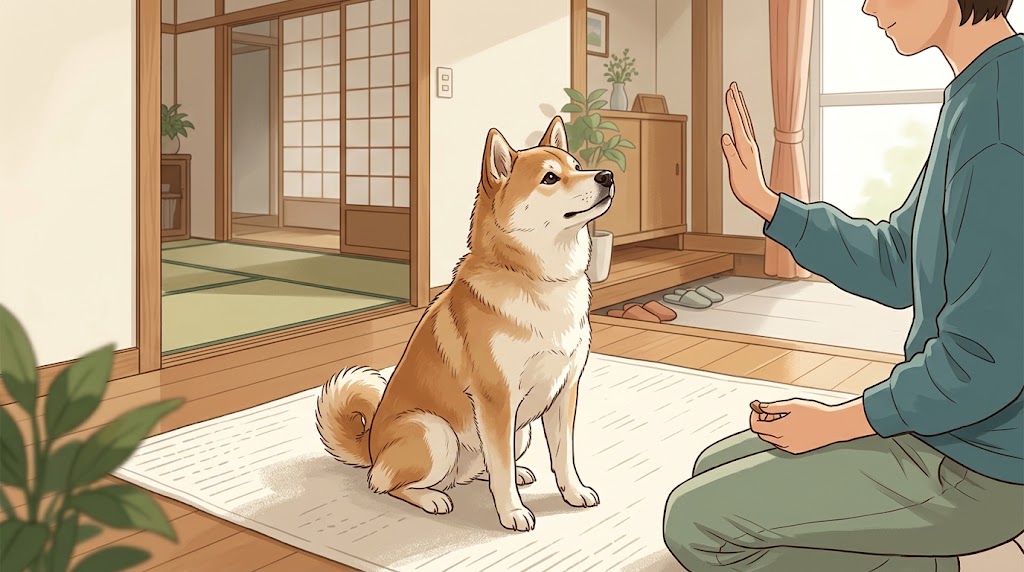
When you start training in Japanese, it can be hard to tell which words are common dog cues and how to say them. Japanese dog commands are practical signals, not just vocabulary to memorize: four useful basics are osuwari (おすわり; sit), fuse (ふせ; down), mate (まて; wait), and oide (おいで; come).
This guide explains what each cue asks your dog to do, offers simple pronunciation help, and shows how to practice with clear timing. Consistency matters more. Choose the same spoken cue and hand signal across your household so your dog does not hear different instructions for the same behavior.
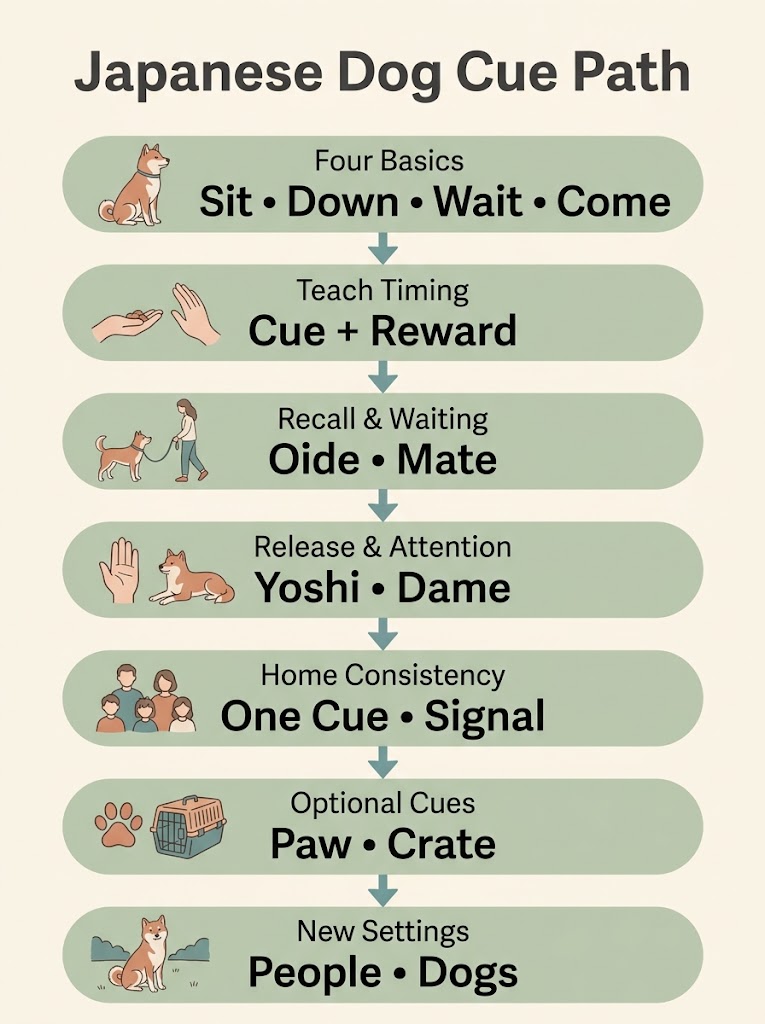
- Japanese Dog Commands: The Four Basic Cues
- How to Teach Japanese Dog Commands With Clear Timing
- Using Oide and Mate for Recall and Waiting
- Japanese Dog Commands for Release, Stopping, and Attention
- Make Japanese Dog Commands Consistent at Home
- Other Japanese Commands for Dogs: Paw and Crate Cues
- Practice Japanese Dog Commands Beyond the Household
- Conclusion
- Sources and Further Reading
- Frequently Asked Questions
Japanese Dog Commands: The Four Basic Cues
Core Cues: Osuwari (おすわり; Sit), Fuse (ふせ; Down), Mate (まて; Wait), and Oide (おいで; Come)
A common point of confusion is whether Japanese dog commands are interchangeable words for general obedience. They are not: the four basic cues have separate jobs. Chiyoda City’s handbook identifies osuwari (おすわり; sit), fuse (ふせ; down), mate (まて; wait), and oide (おいで; come) as basic dog-training cues. These terms are useful starting points, not a reason to switch words mid-training.
Osuwari asks the dog to sit, while fuse asks it to lie down with its body lowered to the floor. Mate means to remain in place rather than move toward you. These cues describe different positions or actions, so saying mate while expecting a sit can make the request unclear. The comparison table summarizes the behavior each word signals.
Oide is a recall cue: it asks the dog to move toward the handler. It differs from mate, which asks the dog to stay where it is. For example, mate can hold a position before oide calls the dog back to you. Choose one of the four cues to introduce first and practice saying it consistently.
| Cue | Meaning | Behavior requested | Say it roughly |
|---|---|---|---|
| Osuwari | Sit | Sit on the floor | oh-soo-wah-ree |
| Fuse | Down | Lie down | foo-seh |
| Mate | Wait | Remain in place | mah-teh |
| Oide | Come | Move toward the handler | oh-ee-deh |
The table separates position cues from movement cues. Osuwari and fuse ask for different body positions, mate asks the dog to remain in place, and oide calls it toward the handler.
The pronunciation guides show each word in easy-to-read syllables rather than formal sound symbols. Together, the meanings and sounds make it easier to distinguish the cues when choosing words for training.
Dog Command Pronunciation in Japanese: Make Each Cue Easy to Recognize
A simple pronunciation guide can help you say each cue in a steady, recognizable way. Try osuwari as “oh-soo-wah-ree,” fuse as “foo-seh,” mate as “mah-teh,” and oide as “oh-ee-deh.” These spellings are practical approximations for English speakers, not exact phonetic notation. The vowel sounds stay clear rather than becoming reduced to a short, indistinct sound.
Say the syllables at an even pace, with no need to force a strong English-style accent onto one part of the word. In mate, for example, keep both syllables audible; in oide, let the vowel sounds follow one another clearly. A calm, distinct cue is easier to tell apart from everyday conversation than a word spoken quickly or mumbled.
The sound matters less than using the same cue for the same behavior. A dog learning fuse can become confused if the word changes between training sessions, even when each version sounds close. Pick the pronunciation that feels natural to your household, then keep its sounds and delivery steady. Each cue works best when it has one clear meaning.
This video demonstrates common Japanese dog commands, including sit, wait, down, come, and shake, with English meanings and pronunciation. It can help you hear how several everyday cues sound before you choose one to practice.
How to Teach Japanese Dog Commands With Clear Timing
Pair the Cue With Praise and a Reward
A cue becomes useful when it predicts one clear behavior, not when it is repeated after the dog has already acted. Say the chosen word as the dog begins the behavior, then mark success with praise and a reward. Pick one cue and reward the behavior while it is happening or immediately afterward.
Timing matters. Chiyoda City’s handbook recommends praising the dog during the behavior or immediately afterward, within five seconds, and offering a reward. That close timing helps the dog connect the response with the praise. If the reward comes much later, the dog may associate it with something else, such as looking away or moving from its position.
Use a short, calm praise word, such as ii ko (いいこ), or say “good,” and keep your tone similar across practice. Reward the behavior as it happens, rather than waiting for several actions to finish. If the dog responds only after hearing the cue many times, pause and make the next practice easier instead of repeating the word.
Practice Sit, Down, and Wait With a Clear Sequence
Keep it simple. For osuwari (おすわり; sit), use a food lure to guide the dog into position, then say the cue as it sits and praise or reward the sit. For fuse (ふせ; down), begin with the dog sitting and move a treat between its front legs. Say the cue and reward when its elbows touch the floor, as Chiyoda City describes.
For mate (まて; wait), first help the dog remain still, then say the cue while it is already holding that position. Yao City’s guidance uses this timing, so the word marks the behavior rather than asking the dog to stop after it has started moving. Praise and reward the stillness before the dog leaves the spot.
Keep each practice sequence distinct: lure, cue, then reward for sit and down; for wait, notice stillness, say the cue, and reward the hold. If the dog moves before receiving the reward, make the wait easier and try again when it can succeed. Yao City cautions against placing food directly in front of the dog during wait practice, since it may prompt the dog to eat quickly.
| Cue | Sequence | Praise or reward |
|---|---|---|
| Osuwari (sit) | Guide into a sit; say cue as it sits | Reward the sit |
| Fuse (down) | From sit, move treat between front legs; say cue | Reward when elbows touch floor |
| Mate (wait) | Say cue while dog is already still | Reward while it holds position |
The sequences differ in when the spoken cue belongs. For sit and down, pair the word with the movement into position; for wait, say the word after the dog is already still. This gives each cue a clear role.
Praise or reward the behavior named in the final column, close to the moment it occurs. If a sequence breaks down, make it easier rather than repeating the cue several times.
Using Oide and Mate for Recall and Waiting
When to Use Oide Instead of Mate
If you are unsure whether to say mate or oide, focus on the movement each cue asks for. Mate (まて) asks the dog to remain in place; oide (おいで) calls it toward the handler. They are not interchangeable. With mate, the expected response is staying in the current spot, while oide means leaving that spot and moving closer to you.
Use mate when the dog needs to pause without changing location, such as while you prepare to call it. Use oide when you want the dog to approach you, for example after it has paused or when you are asking it to return from a short distance. The words describe different jobs, so saying both together can make the requested response less clear to the dog.
Give each cue a separate role and keep the same meaning each time. If you say mate, wait for the dog to stay rather than calling it forward immediately; if you say oide, make the arrival the goal. Chiyoda City’s handbook identifies both as basic training cues and uses waiting before calling the dog toward the handler. This distinction also helps family members give the same instruction.
Practice a Short Recall From Wait to Arrival
Keep the recall short and easy to follow. The sequence is mate, a brief pause, a step away, then oide while showing a reward. Chiyoda City’s handbook describes this kind of progression: ask the dog to wait, move away, call it with a reward visible, then ask it to sit and reward it when it arrives. The cue and the reward point toward one clear outcome: coming to you.
At first, the distance should be small enough that the dog can notice your call and reach you without confusion. When it arrives, calmly ask for a sit if that is part of your routine, then praise and reward the completed response. The arrival matters more than making the dog wait for a long time. If the dog leaves its spot before the call, make the next practice easier rather than repeating the cues rapidly.
Rehearse the wait-and-recall sequence in a familiar, low-distraction place. Keep the words in the same order and use a steady tone, so the dog can learn that mate means pause and oide means approach. As the response becomes reliable in that setting, the same sequence can help you practice recall in other places. Choose surroundings where you can focus on the dog and reward it promptly when it reaches you.
Japanese Dog Commands for Release, Stopping, and Attention
Use Yoshi (よし; Release or Okay) to End a Position Cue
Yoshi (よし; release or okay) can signal that a wait or position has ended. It is not another request to sit or lie down; it tells the dog that the current hold is finished. A release cue ends the hold. Without a clear ending, a dog may leave early or remain unsure whether to keep waiting.
Choose a word household members can say in the same way, then reserve it for releasing a cue rather than using it as general praise. For example, after asking your dog to wait, say yoshi before inviting it to move. Decide which cue will clearly tell your dog that a wait or position is over. The distinction gives the wait a clear beginning and end.
Use Dame (だめ; No or Stop) for an Unwanted Behavior
Dame (だめ; no or stop) can mark behavior you want to interrupt, such as jumping up or taking an item. It does not mean the same thing as a release cue: dame signals that an unwanted action should stop, while yoshi ends a position or wait. That difference matters. If the words are used interchangeably, the dog may not know whether to stop, stay, or move.
Keep dame brief and use it for a clear, specific behavior rather than as a general expression of frustration. When possible, make the next expected behavior clear with a familiar cue, such as asking the dog to sit instead of jumping. Calm, consistent delivery helps distinguish the interruption from praise or permission to move. A single word works best when everyone gives it the same meaning.
Build Attention With Aitakontakuto (アイコンタクト; Eye Contact)
Aitakontakuto (アイコンタクト; eye contact) refers to getting your dog’s attention by having it look toward you. It can help the dog notice a spoken cue or hand signal, especially when there are distractions nearby. Keep the goal simple: a brief look toward you can be enough to regain attention. It is a focus cue, not a command to hold eye contact continuously.
You can build this response by rewarding a moment when your dog looks toward you, then using the same spoken or visual signal before a familiar cue. For example, wait until the dog checks in before asking it to sit. If the dog looks away, reduce the distraction or return to an easier setting rather than repeating the cue many times. Short, clear moments of attention are easier to use in daily routines.
Make Japanese Dog Commands Consistent at Home
Agree on One Spoken Cue and One Hand Signal
A dog can learn a cue in Japanese even when the people around it speak different languages. Trouble often starts when each person uses a different word for the same behavior, or expects the dog to understand a translation automatically. Choose one household word for each behavior, then treat that word as a signal rather than casual conversation.
For example, osuwari (おすわり) is often approximated as “oh-soo-wah-ree,” while mate (まて) sounds roughly like “mah-teh.” These English spellings are guides, not exact sound matches, and a strong accent is not a barrier to learning. Consistency matters more than accent. Say the cue clearly, at a similar volume, and avoid adding extra words that could blur its meaning.
A hand signal can support a spoken cue, especially when the room is noisy or the dog is watching from a short distance. Keep the gesture simple and use the same movement each time; a changing wave or pointing motion can become a separate, unclear signal. Ask everyone who handles the dog to agree on the same spoken cue and signal. Aim for one cue, one signal, one meaning.
Keep Praise Words and Cue Timing Consistent
Praise works best when it follows the behavior the dog is meant to repeat. Chiyoda City’s handbook suggests using a praise word such as ii ko (いいこ), meaning “good dog,” and offering a reward after the desired response. The praise word can be in English or Japanese; the useful choice is one the household can say naturally and consistently.
Timing helps the dog connect the cue, the action, and the reward. Chiyoda City advises praising while the dog is performing the behavior or immediately afterward, within five seconds. For example, if the dog sits after hearing osuwari, praise while it is sitting rather than after it has already stood up. A late reward can make the intended behavior less clear.
Keep praise separate from cues that start or end an action. If mate means stay in place, use a distinct release word, such as yoshi (よし), rather than treating praise as permission to move. The dog can then learn that praise marks success while the release cue ends the position. Anicom recommends that family members use the same spoken cue, pair it with a hand signal, praise success, and practice in different places.
Other Japanese Commands for Dogs: Paw and Crate Cues
Teach Ote (おて; Hand or Paw) and Okawari (おかわり; Other Paw)
These are optional cues. Ote (おて) asks a dog to place one front paw in your palm, while okawari (おかわり) asks for the other paw. Keep your hand low and steady, and reward a gentle paw placement rather than pulling the leg. If your dog withdraws or seems uncomfortable, pause; these cues work best when paw handling stays calm.
Keep paw cues separate from basic cues such as sit or come. You can teach one paw first, then add the second cue once your dog responds reliably to the first. Use the same hand position each time so the spoken word and gesture are easy to tell apart. Paw cues are optional tricks, so there is no need to teach them if they do not suit your dog.
Use House (ハウス; Enter a Crate or Designated Space)
Keep the destination familiar. House (ハウス) is a cue for entering a crate or another designated space, such as a bed or mat. Choose a place where your dog can enter without being pushed or pulled, and make the cue distinct from wait, which asks the dog to remain in place. The word itself matters less than using it consistently for the same destination.
A house cue can help make moving into a resting space part of an ordinary routine. For example, the cue can come before a meal or quiet time, with praise when the dog enters. Avoid using the destination only when you are leaving or ending an activity, since that can make the cue harder to accept. Choose one optional cue that fits your dog’s daily routine and practice it in a familiar setting.
Prepare a Crate (クレート) Cue for Travel or Emergencies
Make entry feel ordinary. Yao City’s dog-training guidance recommends teaching a dog to enter a crate or carrier as preparation for disasters or long-distance travel. The guidance is practical advice from one city, not a nationwide command rule. A crate cue can be useful when your dog needs to settle in a familiar enclosed space, but it is separate from the spoken cue itself.
Kurēto (クレート) means crate; it names the space, while house is the cue you can use to ask your dog to enter. Keep the crate available during calm periods so it is not linked only with travel or stressful events. Praise your dog for entering and staying settled, and let the crate remain a positive, familiar place rather than a punishment.
| Cue | Behavior requested | Situation where it may be useful |
|---|---|---|
| Ote (おて) | Place one front paw in your palm | A simple paw trick or handling practice |
| Okawari (おかわり) | Offer the other front paw | A second paw trick |
| House (ハウス) | Enter a crate or designated space | Settling in a familiar spot |
| Crate preparation | Become familiar with entering a crate | Travel or emergency preparation |
The paw cues ask for a specific paw action, while house asks the dog to enter a chosen space. These are optional skills, not replacements for basic cues such as sit, wait, or come. The table separates each word by the behavior it signals, which can help prevent two cues from becoming interchangeable.
Crate preparation describes a useful training goal rather than another Japanese command. Yao City recommends crate or carrier entry practice for disaster and long-distance travel preparation, but this is local guidance. Choose the cue and destination that fit your routine, then use the same word for the same behavior.
Practice Japanese Dog Commands Beyond the Household
Gradually Practice Familiar Cues in Different Places
A cue learned at home may not be equally clear in a park, apartment lobby, or quiet street. New smells, movement, sounds, and people compete for the dog’s attention, so a familiar word can seem less reliable outside its usual setting. This does not necessarily mean the dog has forgotten the cue; the surroundings have changed what the dog is noticing.
A gradual change in setting can help the dog connect the spoken cue with the expected behavior, rather than with one room or routine. Practice one familiar cue in a new, low-distraction setting before adding more distractions. A quiet corner of a familiar building, for example, can feel different without adding the activity of a busy public place.
Anicom recommends practicing cues in different places, which helps build familiarity beyond the home. If a cue works in one new setting but not another, that difference can show how much the surroundings affect the dog’s response. Context changes what a dog notices. Familiar cues in changing surroundings become easier to understand when the environment changes gradually.
Support Calm Behavior Around People and Other Dogs
People and other dogs can make an ordinary walk more demanding than a quiet practice session at home. A dog may notice movement, voices, or another dog before responding to a familiar cue. Chiyoda City’s handbook recommends socializing dogs so they can behave well around people outside the household and other dogs; this is guidance from one city, not a nationwide rule.
Calm behavior does not mean a dog must approach every person or dog. A composed response can include staying near the handler, watching briefly, or continuing without pulling toward someone. The setting and the individual dog matter: a crowded path can be harder than a quiet open area, and a close encounter can be more distracting than seeing another dog at a distance.
When a dog can respond around mild activity, that experience can support more settled behavior in everyday settings. If attention shifts to nearby people or dogs, the dog may need an easier context before the cue feels familiar again. Keep encounters calm and manageable. Chiyoda City’s socialization advice points to a practical goal: comfortable behavior around people beyond the household and around other dogs, not forced interaction.
Conclusion
Think of Japanese dog commands as a shared way to communicate, not a vocabulary test. A dog does not need a long list of words when each signal has a clear meaning.
Choose one cue to try, agree on its signal with everyone at home, and reward a successful response. Clear signals build trust.
Sources and Further Reading
- Chiyoda City — www.city.chiyoda.lg.jp
- Yao City — www.city.yao.osaka.jp
- Hiroshima Prefectural Animal Welfare Center — www.pref.hiroshima.lg.jp
- Anicom You — mag.anicom-sompo.co.jp
- ote (hand/paw) — www.4paws.jp
Frequently Asked Questions
- QDo Japanese dog commands have to be spoken with perfect Japanese pronunciation?
- A
No. A clear, consistent sound is more useful to your dog than a perfect Japanese accent.
Choose one pronunciation and use it each time. A familiar hand signal can help make the cue easier to recognize.
- QCan I use English and Japanese commands with the same dog?
- A
Yes. You can choose cues in English, Japanese, or a mix of both.
The key is to avoid switching unpredictably. Agree on each cue with everyone who handles the dog, so the same behavior has the same signal.
- QWhat is the difference between mate and yoshi?
- A
Mate (まて; wait) asks your dog to remain in place. Yoshi (よし; release or okay) can signal that the wait or position has ended.
Use them as separate cues: give mate while the dog is holding still, then use yoshi to release the dog.
- QWhich Japanese dog command should I teach first?
- A
Osuwari (おすわり; sit) is an accessible early cue; the Hiroshima Prefectural Animal Welfare Center recommends it as a starting point.
You can also choose a cue that meets an immediate need, such as coming when called. Pair practice with timely praise and a reward; Chiyoda City’s handbook recommends praising during the behavior or immediately afterward.